
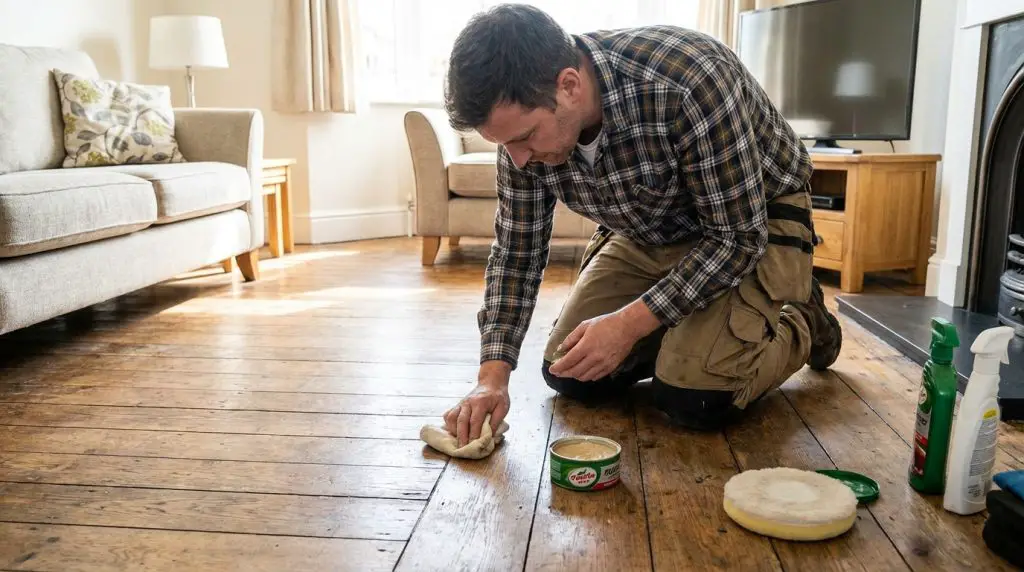
In the world of high-end woodworking, there’s a persistent rumor that the secret to a mirror-like, bulletproof finish isn’t in a woodworking catalog—but in the automotive aisle.
To purists, putting a product made for a Ford F-150 on a hand-planed walnut credenza feels like sacrilege.
Yet technically, your car’s clear coat and your dining table’s polyurethane are close cousins. Both are synthetic polymers built to shield a vulnerable surface from the outside world.
If you’ve admired the deep, liquid reflection of a freshly detailed supercar and wondered why your mahogany desk looks flat, you’ve found the heart of the debate.
Car wax is engineered to survive UV rays, high-speed rain, and acidic grime. Using it indoors isn’t just polishing—it’s overengineering.
But before you buff your heirlooms like they’re headed to a concours show, it’s worth asking: is this a clever crossover, or a fast track to a greasy mess?
Let’s break down the chemistry behind the automotive-wood experiment.
What Can Car Waxes Do to Wood?
At its core, wood is a biological sponge. It’s porous, it breathes, and it reacts to humidity.
Car paint, conversely, is a non-porous, rigid layer of clear coat over metal. Because these surfaces are fundamentally different, car wax behaves differently when it hits grain.
The Chemical Composition
Most high-quality car waxes are a blend of Carnauba wax (derived from the Brazilian palm Copernicia prunifera), beeswax, petroleum distillates, and often synthetic polymers or silicones.
When you apply car waxing wood techniques, the distillates act as a carrier, allowing the wax to spread before evaporating and leaving a hard film behind.
The Mechanical Bond
On a car, the wax sits on top of the clear coat. On wood, the wax attempts to penetrate the fibers or fill the microscopic “valleys” of the wood grain.
If the wood is raw (unsealed), the car wax will soak in, potentially darkening the wood unevenly.
If the wood is already finished (lacquer, polyurethane, or shellac), the car wax acts as a sacrificial layer, providing a temporary barrier against light scratches and moisture.
The Silicon Threat
Here is the technical “gotcha”: many modern car waxes contain silicones.
While silicone provides incredible “slip” and water sheeting on a car, it is the mortal enemy of furniture refinishing.
If silicone seeps into the wood grain, it can cause “fish eyes”—tiny craters—the next time you try to apply a real wood finish or paint. It’s a permanent guest that refuses to leave.
Advantages of Using Car Wax Finish for Wood
Despite the warnings, there are reasons people swear by this.
If used correctly—specifically on top of an existing, intact hard finish—car wax can offer some surprising benefits.
1. Superior Hardness: Carnauba is one of the hardest natural waxes known to man.
In its pure form, it has a higher melting point and greater durability than standard furniture pastes. This makes it excellent for high-touch surfaces like tabletops.
2. Enhanced UV Protection: Modern car waxes are packed with UV inhibitors designed to stop paint from fading in the sun.
If you have a wooden piece sitting near a south-facing window, a car wax layer can help mitigate sun bleaching.
3. Water Sphericity (Beading): Car waxes are engineered for extreme hydrophobicity.
Water will bead up and roll off a waxed wooden surface much more effectively than with standard furniture polish, protecting against those dreaded white water rings.
4. The “Pop” Factor: Car waxes often contain “optical brighteners” and oils that fill micro-scratches in the existing finish, giving the wood a deep, wet-look luster that is hard to achieve with supermarket-grade sprays.
Disadvantages of Using Car Wax on Wood Floors and Furniture
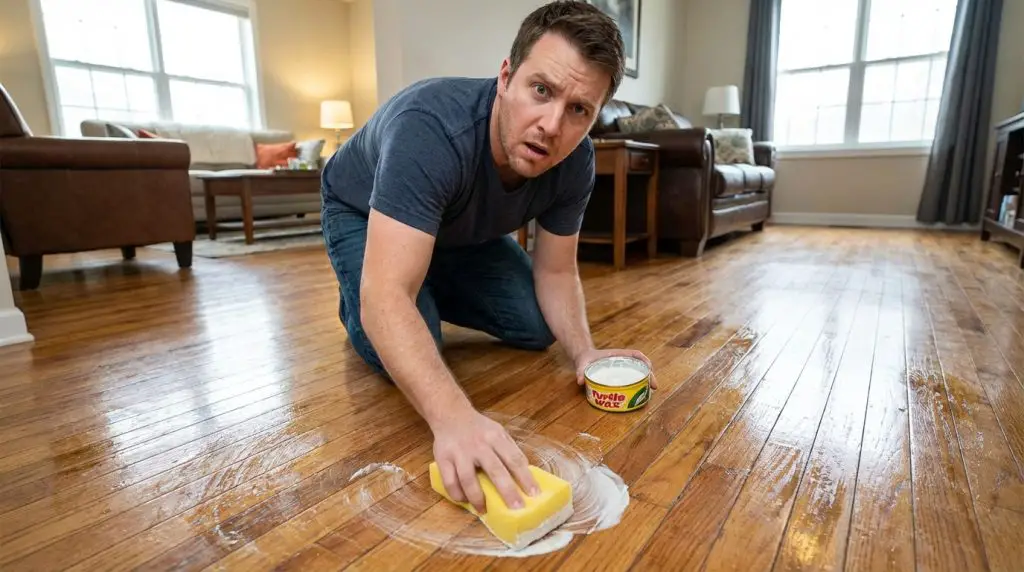
Before you go car waxing wood floors throughout the house, we need to address the “slip and slide” factor and the long-term maintenance headaches.
1. The Safety Hazard (The “Bambi” Effect)
Applying car wax to wood floors is generally a terrible idea for one major reason: friction, or lack thereof.
Car wax is designed to be slick to reduce wind resistance and prevent dirt from sticking. On a floor, this turns your hallway into a skating rink.
Unlike a dedicated floor wax, which has additives for traction, car wax can be dangerously slippery, especially if you’re wearing socks.
2. Solvent Sensitivity
The solvents used in car waxes (like naphtha or mineral spirits) are designed to be safe for automotive clear coats, but they can be aggressive toward certain wood finishes.
If you apply a solvent-heavy car wax to an old shellac finish, it might actually soften or dissolve the underlying layer, leaving you with a sticky, cloudy mess.
3. Difficulty of Repair
Unlike beeswax finish or standard furniture waxes, which can be easily stripped with a light wipe of mineral spirits, car waxes—especially synthetic liquid “waxes”—are designed to be detergent-resistant.
If you decide you want to stain or paint the piece later, getting that car wax out of the grain is a Herculean task.
4. Build-up and Clouding
Car waxes are often thicker than furniture polishes.
Over time, repeated applications can lead to a cloudy “wax build-up” that obscures the natural beauty of the wood grain.
Instead of a clear view of the oak, you end up looking through a hazy, yellowish film.
The Technical Verdict: When Should You Use It?
If you have a piece of outdoor furniture that is already sealed with a robust polyurethane, a thin coat of high-quality car wax (non-abrasive) is actually a brilliant move. It provides an extra layer of defense against the elements.
However, for indoor antiques or hardwood floors, keep the car wax in the garage. Use a dedicated wood paste wax that is formulated to be “breathable” and easily removable.
FAQs
Is car wax food-safe for cutting boards?
No. Car waxes contain petroleum distillates and synthetic chemicals that are not intended for ingestion. For anything touching food, stick to food-grade mineral oil and pure beeswax.
Will car wax fix scratches in my wooden table?
It won’t fix them, but it will mask them. The wax fills the scratch, changing how light reflects off the surface, making the scratch less visible to the naked eye.
How do I remove car wax if I messed up?
You’ll need to use a “wax and grease remover” from an auto-body shop or odorless mineral spirits. Work in small sections, changing your cloth frequently so you don’t just spread the wax around.
Final Thoughts
Using car wax finish on wood is a classic example of “just because you can, doesn’t mean you should.”
While the technical properties of Carnauba offer tempting durability and a stunning shine, the risks of permanent silicone contamination and “slip-and-fall” floors are significant.
If you’re working on a rugged outdoor project or a modern piece with a thick, indestructible finish, go ahead—give it that showroom shine.
But if you’re dealing with the living room floor or Grandma’s cedar chest, stick to the products designed by people who spend more time in woodshops than at the track.

We are constantly finding new ways to update our home exteriors. If you are a bit tight on budget, renovating Read more

Cypress wood has been used for thousands of years in shipbuilding, so it is well-known for its water-resistance properties. Due Read more
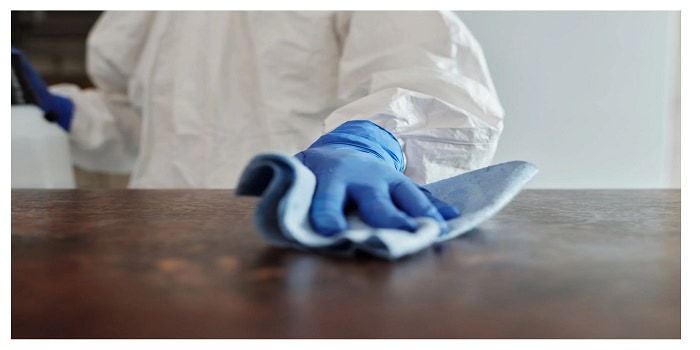
We all know - Heat is the enemy of wood. When you place a hot item on a wooden surface Read more

If you are looking to upgrade your dining room but are on a budget, then painting your oak table and Read more
Hi, I am Mark Garner a professional carpenter, woodworker, and DIY painter. I live in the small city of Peoria, Arizona as a semi-retired woodworker. I have started this blog with a simple motive to help you with my wood experience in this sector. If you like to know more about what I love doing and how it all got started, you can check more about me here.